The Death Sentence That Sets You Free: Why God Breaks Your Self-Sufficiency
Related Episode
S1E2: The Sentence You NeedThere’s a sentence you need to hear. It’s not the one you want, but it’s the one that will save your life.
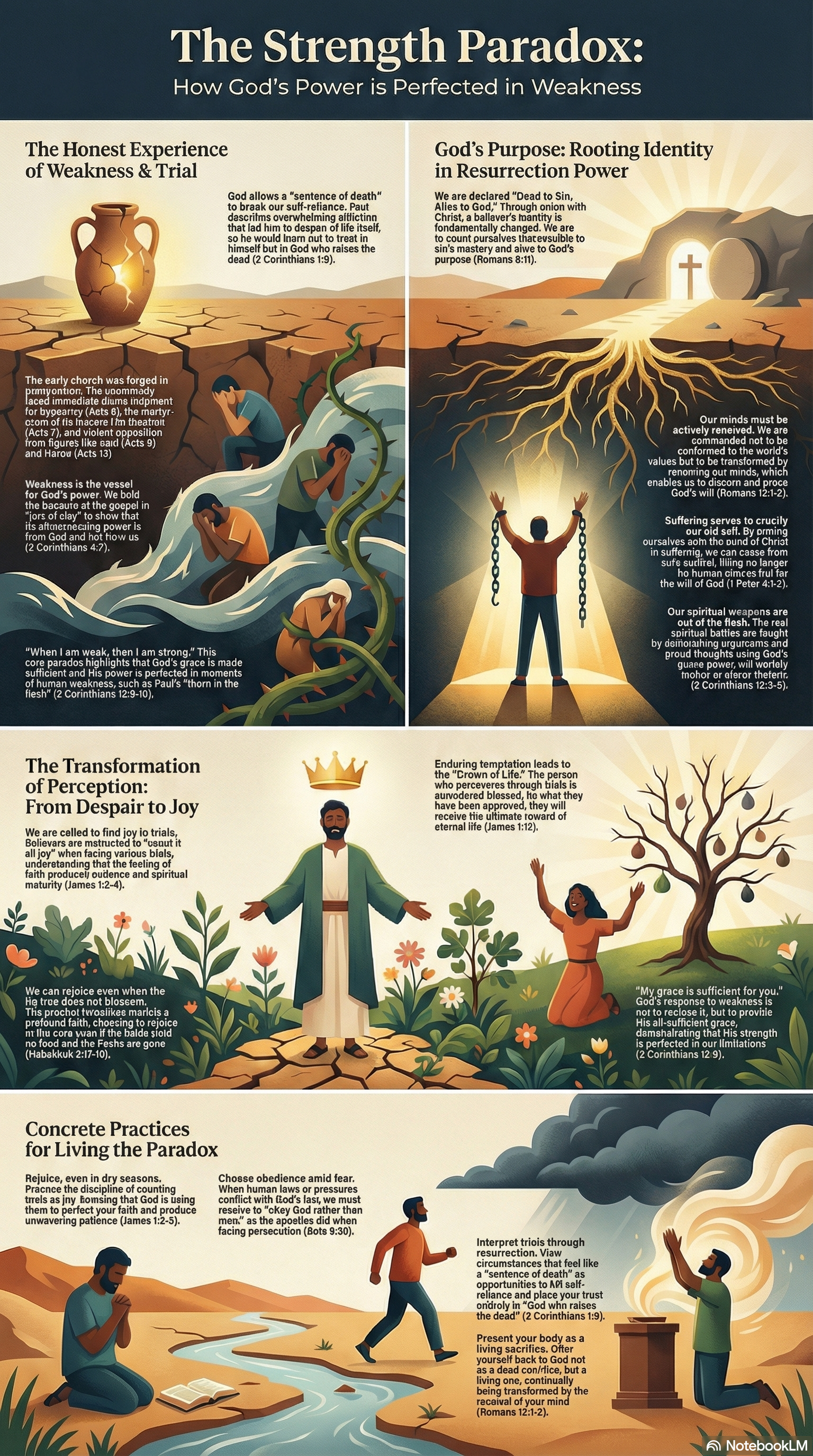
Paul received his in Asia. “We were so utterly burdened beyond our strength that we despaired of life itself. Indeed, we felt that we had received the sentence of death” (2 Corinthians 1:8-9). But here’s what most miss: this wasn’t punishment. It was mercy. God’s surgical strike against the idol that maxes out Kingdom effectiveness at 20×—self-sufficiency.
The Four Towers That Must Fall
Every believer constructs them. Four towers of self-reliance that feel like strength but function as shackles:
Intellectual - Your theology, your understanding, your ability to figure it out
Financial - Your resources, your security, your ability to fund solutions
Operational - Your systems, your networks, your ability to make things happen
Material - Your possessions, your platform, your tangible assets
These aren’t inherently evil. They’re gifts. But when they become your foundation instead of God’s provision, they become prisons. Self-reliance feels empowering until you discover its ceiling: 20× return. Good fruit, but not Kingdom fruit.
The Watch-Wait-Work Framework
Paul’s death sentence introduced him to a different mathematics. “But that was to make us rely not on ourselves but on God who raises the dead” (2 Corinthians 1:9). This is the Watch-Wait-Work framework that unlocks 30-60-100× multiplication:
Watch - God orchestrates circumstances beyond your control or comprehension
Wait - You’re forced into a position where human solutions are exhausted
Work - God moves through resurrection power, not human effort
This isn’t passive resignation. It’s active dependence on the God who specializes in impossible situations. The same God who raised Jesus from the dead doesn’t need your four towers. He needs your surrender.
The Pattern Repeats
Scripture documents this demolition-to-multiplication pattern with surgical precision:
Jonah thought he could outrun God’s call. Three days in darkness taught him that self-directed ministry yields zero fruit, while surrendered obedience transforms entire cities.
Peter trusted his own courage until it collapsed in a courtyard. The disciple who denied Christ three times became the apostle who preached to thousands—but only after his self-confidence died.
Paul had every human credential (Philippians 3:4-6). Pharisee of Pharisees, blameless under the law, zealous beyond measure. All of it had to be counted as loss before he could access the power that raised Christ from the dead.
Same breaking. Same rescue. Exponential fruit.
Why God Demolishes What You’ve Built
The mathematics are merciless. Self-sufficiency caps Kingdom effectiveness because it operates from human capacity. No matter how gifted, how resourced, how connected you are—flesh maxes out at 20×. It’s not sustainable, not scalable, and not supernatural.
But surrender? Surrender unlocks resurrection power. The same force that conquered death doesn’t operate by human limitations. It multiplies five loaves into thousands fed. It transforms cowards into martyrs. It uses foolish things to shame the wise.
Your four towers aren’t being demolished because God is cruel. They’re being demolished because they’re blocking access to power that operates beyond natural law. The sentence of death isn’t punishment—it’s preparation for resurrection mathematics.
The Mercy Hidden in the Breaking
Paul called his Asian crisis “the sentence of death,” but notice what it produced: “But that was to make us rely not on ourselves but on God who raises the dead.” The breaking wasn’t random suffering. It was targeted mercy, designed to kill what was killing his Kingdom effectiveness.
This is the upside-down logic of the Kingdom. Death precedes life. Weakness unlocks strength. Surrender produces victory. What feels like divine abandonment is actually divine preparation for exponential impact.
Your current crisis—financial, relational, ministry, health—might be God’s mercy disguised as judgment. The towers you’ve spent years building might need to fall not because they’re evil, but because they’re insufficient for what God wants to do through you.
From Self-Reliance to God-Dependence
The transition isn’t comfortable. Moving from 20× self-sufficiency to 100× God-dependence requires the death of everything you’ve used to measure security and success. It means embracing the sentence of death to your own capabilities, your own understanding, your own resources.
But here’s the scandalous truth: God who raises the dead isn’t limited by your limitations. He doesn’t need your four towers. He needs your trust in His resurrection power. He needs you to stop relying on what you can see, control, and understand, and start depending on what He can do through impossibility.
The sentence you need isn’t affirmation of your strength. It’s the death of your self-sufficiency. It’s the demolition of whatever keeps you operating at human capacity instead of divine power.
Paul learned it in Asia. Jonah learned it in the fish. Peter learned it in the courtyard. The pattern repeats because the principle remains: God uses broken vessels to display resurrection power.
Your Sentence Awaits
The question isn’t whether you’ll receive your sentence of death. The question is whether you’ll recognize it as mercy when it comes. Whether you’ll let it kill what needs to die so resurrection power can flow through what remains.
Your four towers will fall. They always do. The only question is whether you’ll fight the demolition or surrender to the God who raises the dead.
Ready to explore how God’s “sentence of death” might actually be His greatest mercy in your life? Listen to the full episode of The Upside-Down Kingdom for the complete breakdown of Paul’s Asian crisis and the Watch-Wait-Work framework that unlocks Kingdom multiplication. This is Episode 2 of our 15-part journey through the personal idols that cap our Kingdom effectiveness—don’t miss the surgical precision of what God is dismantling in your life.